
Richmond County Tax Record Coverage
Richmond County splits the tax job between two offices. The Commissioner of the Revenue keeps the assessment roll, the property cards with owner information, and the tax maps. The Treasurer bills and collects. Payment status and account-balance questions go there. A careful property tax review may touch both offices, one for the assessed parcel and one for the amount now due.
| Field | What It Shows | Where |
|---|---|---|
| Assessment | Land, improvements and total assessed value at the applicable date | Commissioner property cards and reassessment cards |
| Annual bill | Amount due and payment status | Treasurer inquiry, portal or office |
| Land Use | Application and assessment treatment under the county program | Commissioner of the Revenue |
| Tax relief | Disabled-veteran real-estate exemption oversight | Commissioner of the Revenue |
| Tax map | Parcel location and account/map reference | County printable sheets and GIS |
The county's latest general reassessment took effect January 1, 2024. It values real estate at 100% of fair market value using recent county sales. That figure is not a sale price. Neither the assessed value nor a sale price tells you the tax bill. The Treasurer holds payment status. So use the property card only to find the parcel and understand its appraisal.
Richmond County's 2024 Reassessment
The county says general reassessment occurs every four to five years. The latest effective date is January 1, 2024, and real estate is valued at 100% of fair market value based on recent county sales. Use the reassessment card search for that dated view; it is not a live title register.
The county materials carry a second date that matters: deeded owners are as of December 31, 2022. A transfer recorded after that day may not be reflected in the owner snapshot. For an assessment question, contact the Commissioner; for a newer deed, search the Clerk's recorded index. Do not resolve a mismatch by assuming the sale failed to record or by treating an older card as a title certificate.
The Richmond County reassessment portal is the source for the dated assessment search pictured here.
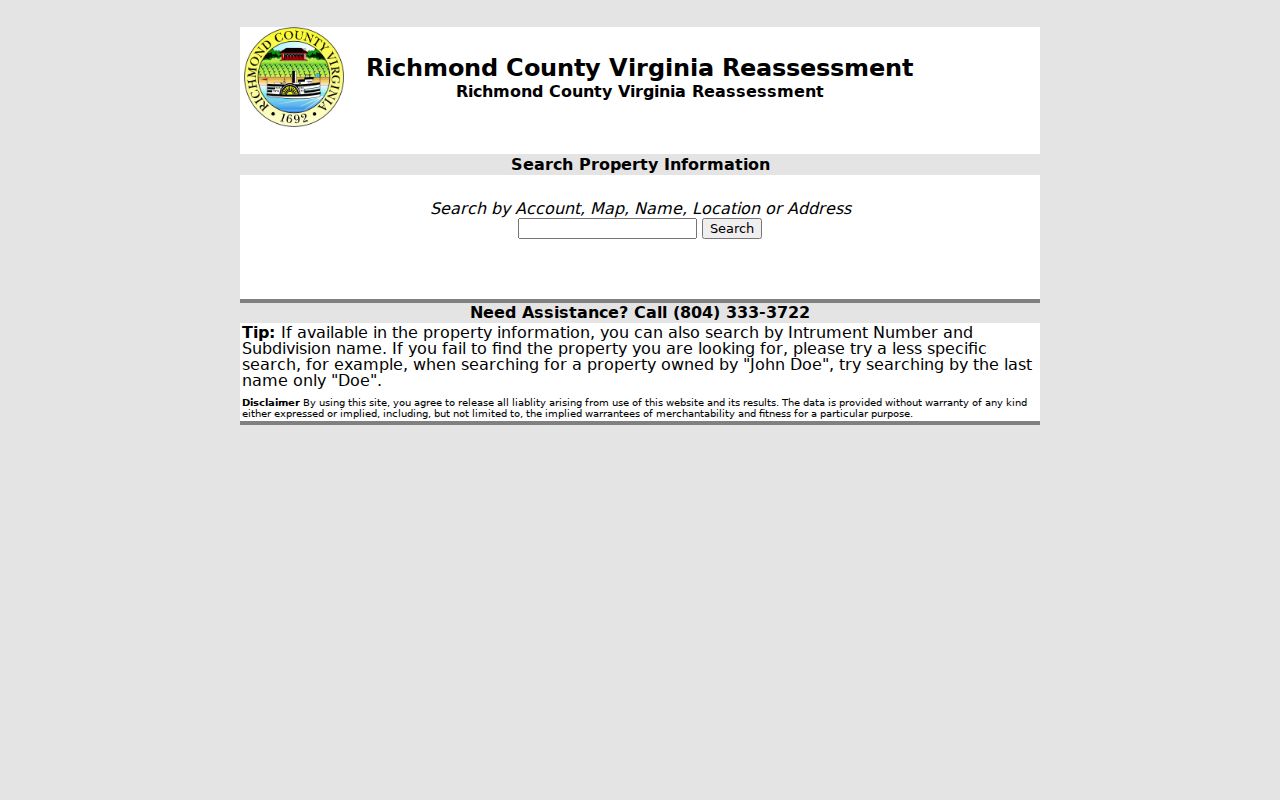
Read the taxable value against the 2024 assessment date. For transfers recorded after the December 31, 2022 owner snapshot, rely on the Clerk's deed index.
Richmond County's December Tax Cycle
Real estate in Richmond County is assessed each January 1 and billed once a year. Payment is due December 5. A 10% late penalty begins December 6. Interest at 10% per year starts on January 1. This is not a twice-yearly billing schedule. A missing statement does not pause the obligation. In the county's words, the taxpayer must still pay on time. So call the Treasurer to confirm the account number and amount.
Checks or money orders go to the Richmond County Treasurer's Office, P.O. Box 400, Warsaw, VA 22572. Make them payable to "Richmond County, Warsaw, VA," with the account number noted. A postmark on or before the due date counts as timely. The office at 101 Court Circle takes Visa, MasterCard and Discover. Its 24-hour drop box accepts checks or money orders but not cash. Phone payment runs through 1-866-549-1010 with bureau code 1204429.
The annual due date and payment options come from the Treasurer's official tax-billing page.
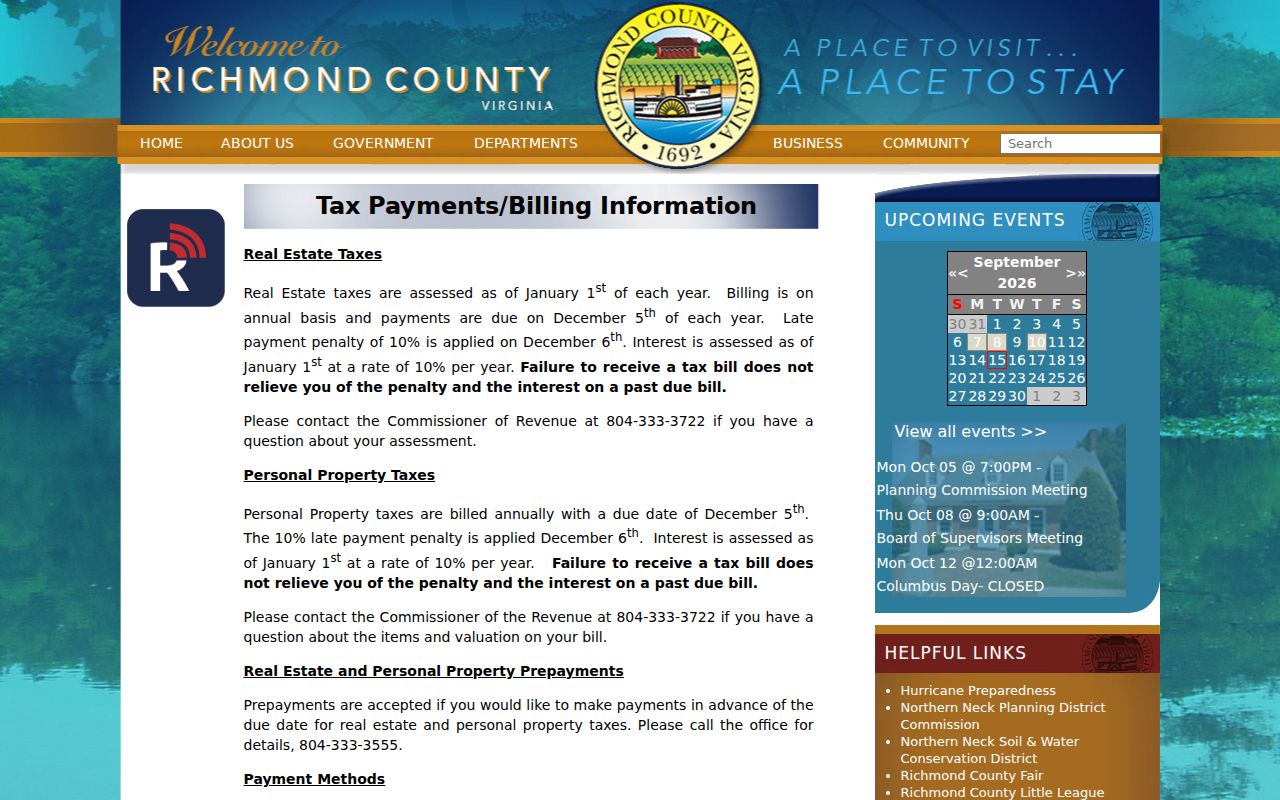
Always send the account number with a payment. Verify the balance with the Treasurer, since a tax card is not an account statement.
Richmond County's New Tax Portal
The county pegs April 2025 as the launch of its new Treasurer customer portal. It handles real-estate tax inquiry and payment. The online-services page lists it beside other county tools. Card and e-check payments add a convenience fee, calculated before you authorize anything. Phone, mail, in-person and drop-box payment still work.
The county publishes little detail on the portal's search fields. Have the parcel account number ready. If an online lookup misses, call the Treasurer. A broad property search belongs with the Commissioner's card. A balance or payment receipt belongs with the Treasurer. Keeping those tasks apart prevents mix-ups among assessed value, tax due and recorded ownership.
Need current payment instructions and contact channels? The county's Tax Payments and Billing Information page is the place to check.
Richmond County Relief Programs
The Commissioner of the Revenue runs two real-estate relief programs in Richmond County. These are the Land Use Program and the disabled-veteran exemption. Both route through one office. The Commissioner accepts and oversees the applications. Other local exemptions may exist. Treat these two as a starting point, not a full catalogue.
For a specific parcel, ask which program applies and what filing documents the county requires. Confirm the assessment reflects an approved application. The Treasurer can explain a billed balance. But that office neither sets valuation nor performs the Commissioner's assessment duties. Keep two records separate in any purchase or estate file. The application is one document. The tax bill is another.
Land Use enrollment and disabled-veteran relief carry distinct eligibility rules and filing steps. A previous owner's approved status does not transfer to a buyer. Confirm the current county application directly instead. When reading a parcel card, note any special assessment context. Keep it apart from the annual amount billed. For a balance, identify the parcel account. Then ask the Treasurer whether a payment, penalty or interest charge has posted.
Find a Richmond County Tax Bill
Start with the county property card when the account number is unknown. Take that identifier to the Treasurer's real-estate tax inquiry. The card and the bill are different records. Assessment questions go to the Commissioner at (804) 333-3722, while tax balance and payment questions go to the Treasurer at (804) 333-3555. A missing statement does not cancel the duty to pay. Verify the account directly rather than trusting the card to show the balance.
- Find the parcel's account or map number through the public Property Cards interface.
- Ask the Treasurer's online portal or staff for the real-estate balance and payment status.
- Read the assessment year separately from the bill year; the Commissioner handles valuation questions.
- Choose online, phone, mail, drop-box or counter payment, and review any fee before authorizing.
- Assessment
- The Commissioner's value for the county tax roll at the stated assessment date.
- Tax bill
- The Treasurer's charge and payment record for a tax year.
- Land Use Program
- A county application program overseen by the Commissioner; confirm parcel treatment there.
- Delinquency
- An unpaid balance tracked by the Treasurer, separate from a recorded deed or lien.
Richmond County Payment Channels
Richmond County offers more than an online portal for tax payments. Checks and money orders go to the Treasurer at P.O. Box 400, Warsaw, VA 22572, and each should include the account number. A postmark by the due date counts as timely. The office at 101 Court Circle takes Visa, MasterCard and Discover during business hours, while a 24-hour drop box accepts checks and money orders but no cash.
Phone payments use 1-866-549-1010 with bureau code 1204429. The Treasurer can confirm an account number and amount at (804) 333-3555. Online card and e-check payments carry a convenience fee, shown before authorization. Use the county online-services hub for current links. Contact the Treasurer if the portal does not find a parcel.
Richmond County Delinquency Records
A past-due balance, a court sale and a completed transfer are different events. The Treasurer comes first for a balance. Payment status comes from the same office. A foreclosure, partition or judicial sale may have its own civil or chancery court file. A finished conveyance should then appear in the Clerk's land-record index. It may be a trustee's deed, a commissioner's deed or another instrument.
The county publishes no current public Richmond County tax-sale list or annual sale calendar. Ask the Treasurer which delinquency record exists. A Virginia FOIA request can obtain an existing list. Don't label a card "tax sale" on a balance alone. To check title or a sale, follow the court file. Also follow the recorded deed as a separate record.
Online case information may not show the whole file. The county's Circuit Court contact page provides the local office route when that happens.
Appeal a Richmond County Assessment
Richmond County's administrative appeal page describes relief under Virginia Code Title 58.1, Chapter 39. That path applies when the Commissioner made an error or a general reassessment contains a factual error. A written appeal has required parts. Identify the taxpayer, tax period and disputed amount. State the correction or remedy sought. Then explain the alleged error and grounds, provide the relevant facts, and expect the Commissioner to issue a written determination within 90 days after filing.
Check the filing window. The county's page gives general timing of three years from the end of the tax year or one year from the assessment date, whichever is later. Confirm the current form and parcel-specific deadline with the Commissioner before filing.
The county links a Real Estate Appeal Form. Its exact fields are not listed on the page. Pull a copy before filing. Keep the card, the disputed assessment and any evidence tied to the factual error. The county appeals page describes the administrative route. Circuit-court relief adds its own legal standards. Check those with the Clerk or counsel.
An assessment appeal is not a payment dispute. The Commissioner handles valuation and factual assessment errors, while the Treasurer tracks collections and balances. Each party to a parcel that changed hands should verify which tax period and owner date the record reflects, and keep correspondence, filing copies and the written determination with the card and deed so the next question reaches the correct office. The Richmond County administrative appeals page is the source for the filing procedure.
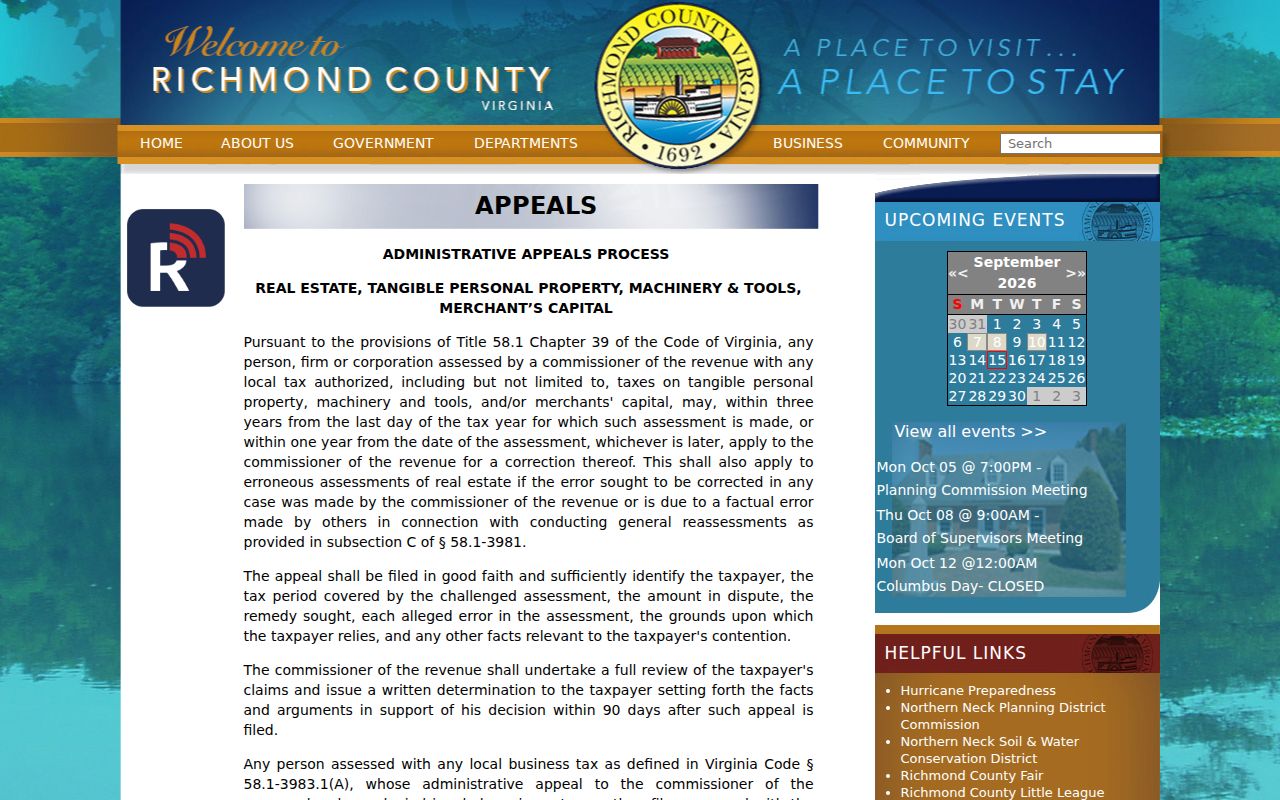
The county links the form but does not resolve each parcel's filing deadline here. Contact the Commissioner before filing, and preserve the supporting assessment evidence.