
Richmond County Deeds and Instruments
A deed captures one transfer within Richmond County's permanent land record. It documents a conveyance or other stated transfer of interest. Related instruments do different work. Some secure a loan. Others release an interest. A few give notice of a case. The Circuit Court Clerk records deeds, deeds of trust, certificates of satisfaction, releases, plats, mechanics' liens, and lis pendens. The office also records other listed instruments. Read the type before calling it a sale with clean title.
| Deed Type | What It Does | Common Use |
|---|---|---|
| Deed | Records the stated conveyance and legal description | Follow grantor and grantee names through the index |
| Quitclaim deed | Transfers whatever interest the grantor conveys, without a warranty of title | Read the parties and consideration in context |
| Deed of trust | Records a security interest tied to a loan | Look for a later release or certificate of satisfaction |
| Trustee or commissioner's deed | Records a transfer by a named fiduciary or court officer | Pair with the related estate or court file |
| Plat | Shows approved lots, dedications, easements and divisions | Use with the deed and approval record |
A deed of trust is not a sale. It secures a debt. The parcel does not pass to the lender the way it would in an ordinary conveyance. A certificate of satisfaction or release follows. A plat works differently too. It can lay out lots, roads, easements and common areas without serving as the conveyance itself. Before deciding what a record means, check the parties, the legal description and any later instruments. The Circuit Court Clerk's land-record page explains the county's deed-index and scanned-image access.
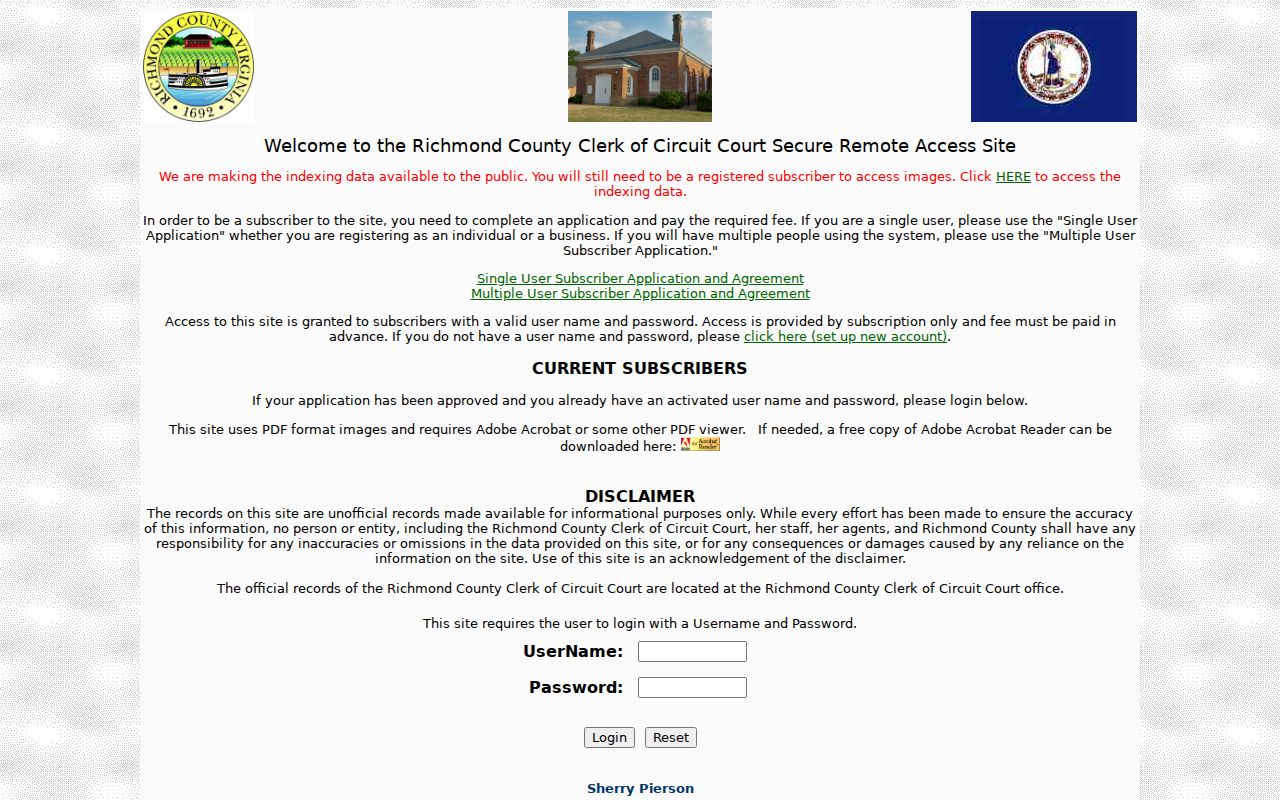
Write down every index citation before requesting a copy. Approved subscriber credentials and advance payment open the image access the county describes, so have both ready.
Richmond County SRA Index and Images
Richmond County's Secure Remote Access page splits its records in two. Index data stays public. Deed images do not. Opening them calls for an approved subscriber name and password, with payment in advance. The state Virginia SRA portal notes that a local clerk may offer free index-only access, and the local office sets the rules for images. A public index reveals the parties and a book, page or instrument reference. It does not unlock the scan. A subscription decides that. County online-services material says circuit records are computerized back to 1753. That reach is unusual. Subscriber rates differ for individual and business accounts, and the Clerk's landing page still points users toward approved credentials. The notices may carry no update date. Check the current terms before entering payment details. For a single deed image, the counter at 101 Court Circle or a direct copy request may be the more practical route, and the county publishes no specific per-page copy price. The index is a route, not a verdict. It points toward the official record without settling that record's full legal meaning. The Richmond County Clerk of the Circuit Court is at 101 Court Circle, P.O. Box 1000, Warsaw, VA 22572, phone (804) 333-3781, Monday through Friday, 9 a.m. to 5 p.m.
Richmond County's Permanent Land Series
The Library of Virginia retention schedule classifies deeds as permanent records. Once recorded, they stay. Richmond County's series runs wide. It holds assignments, bills of sale, certificates of satisfaction, deeds of release, deeds of trust, grants, homesteads, leases, mechanics' liens, mortgages, lis pendens, powers of attorney, quitclaims and transfers. A thorough deed search goes beyond documents labeled deed. Debt, access, litigation and older ownership questions can hide in those other instruments. Search each party as grantor and as grantee. An assignment can move a secured interest without any new sale. A release can close that line. A lis pendens is notice of litigation, not a finding that one party won. A plat may record a new layout. It can also point back to the source tract's earlier deed book and page. Each instrument supplies one link in the chain. The Library of Virginia local-records schedule names the durable record categories. Use the Clerk's index and legal description to see which apply. Not every category touches one parcel.
Richmond County Deeds Since 1692
Richmond County was formed in 1692 from old Rappahannock County. Its deeds run deep. The Library of Virginia catalog lists Deed Book 1 for 1692–1693, Deed Books 2 through 39 across the ensuing centuries, General Index to Deeds 1 covering 1692–1860 and General Index 2 covering 1860–1915. Those entries are microfilm finding aids. They do not promise that every page sits online. Deed Book 2 and Book 14 share reel 1, so a reel number cannot be guessed from the book number alone. The catalog also flags burned and mutilated volumes of unknown cause. Will books before 1699 are missing. Order books from 1794–1816 are gone too. Numerous loose records before 1781 are absent as well. Those losses argue for widening a search rather than declaring that a transfer never happened. Follow later deeds, general indexes, plats and adjoining owners when one volume is missing. Microfilm is the medium here. The LVA Richmond County catalog lists book ranges, reel details and the plats series. The Library of Virginia catalog for Richmond County shows the historical deed-book and index series.
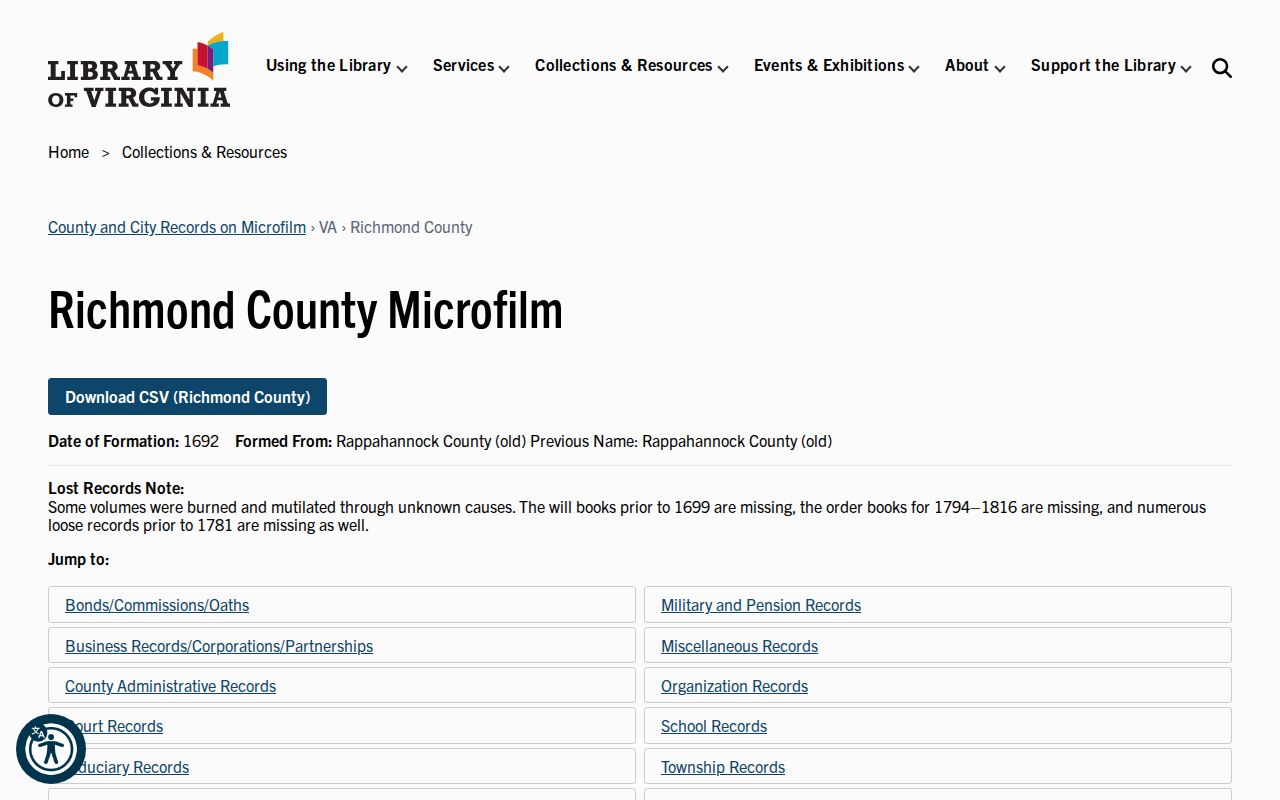
Catalog ranges let you work backward volume by volume instead of guessing at an online date filter. Some historic books and loose records are simply gone.
Richmond County Plats Reach the Clerk
Before a plat reaches permanent land records, it travels through Planning and Zoning. Property divisions and boundary-line adjustments need county approval first. The sequence can include preliminary plat review, health or VDOT signoff when conditions require it, notarized owner consent, final county approval, and recording with the Circuit Court Clerk. Richmond County's subdivision form asks for the owner's name, acreage, district, restrictions, and the source deed book and page with conveyance dates. That paperwork is what links a new lot back to its parent tract.
Warsaw adds its own review layer. Plats and replats inside town, or within one mile of its limits, need town council approval before the Richmond County clerk can record the instrument. This is why a planning packet, a final plat, and the deed index may carry different dates and sit with different custodians. The county's plat approval page lists the steps and fee categories; confirm current charges before filing. The county plat-approval instructions walk through the review that precedes recording.
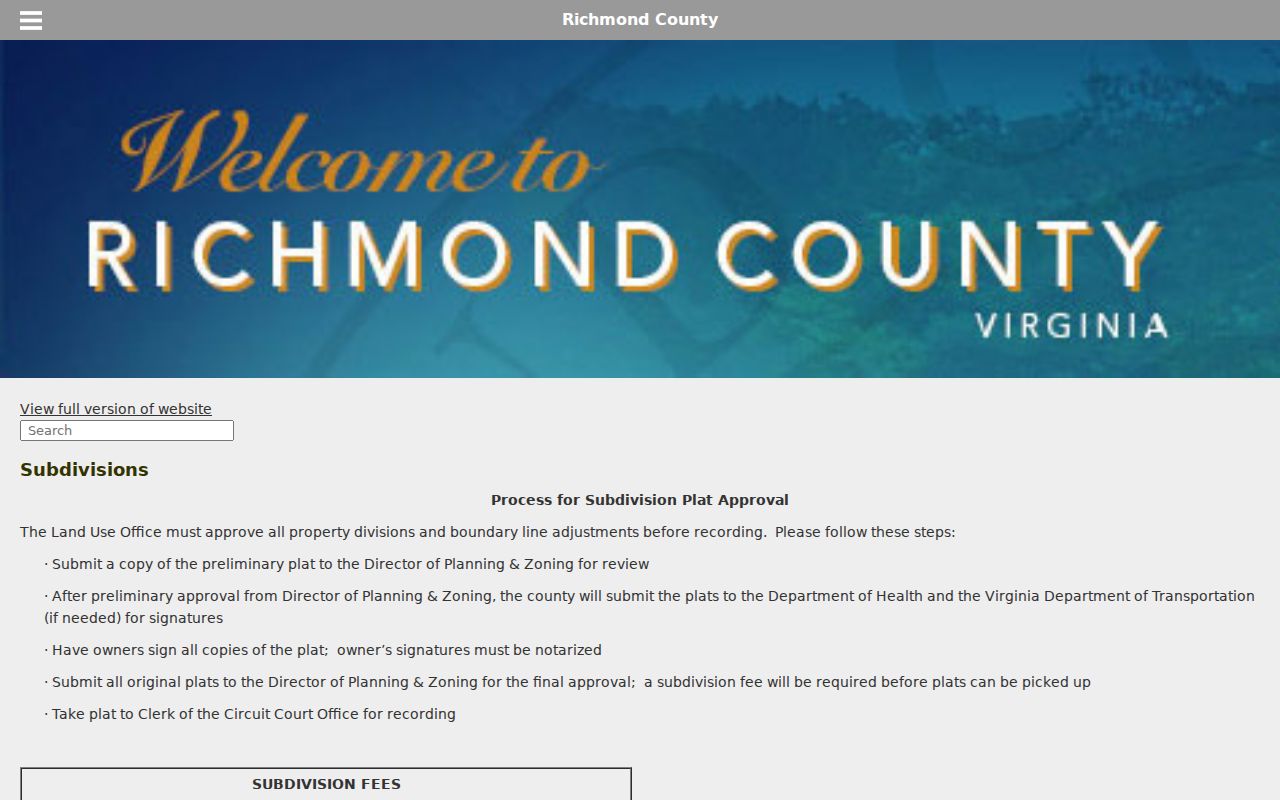
A final survey or plat attached to an instrument can explain a deed's calls and lot references. An approval application alone is not proof the lot was recorded.
Richmond County Grantor-Grantee Trail
The grantor conveys the interest. The grantee receives it. Richmond County's online land index works as a party-name index rather than a parcel-number search. Start with the current owner of record as grantee. Note the deed reference and legal description. Then search that same name as grantor to reach the next transfer back in time. The public landing page does not display its exact form labels or date coverage. Follow the posted index instructions instead of assuming an address field exists.
- Search the known owner's exact name as grantee and note the recording date and book/page or instrument number.
- Read the grantor and legal description, then check that the district, acreage or adjoining lands fit.
- Search the prior grantor as grantee to find the deed that brought the property to that party.
- Repeat through earlier indexes; use Library of Virginia books and microfilm when the online trail stops.
- Grantor
- The party conveying an interest in the instrument, often but not always a seller.
- Grantee
- The party receiving the interest described by the recorded instrument.
- Chain of title
- The sequence of recorded transfers and related instruments used to trace ownership history.
- Book/Page
- A volume and page reference used in older Richmond County citations.
- Instrument number
- A document reference when shown by the modern index or card.
Names demand care. Initials, married names, entity suffixes, and estate names can shift from deed to deed. A name-only hit proves little. Compare the legal description and surrounding parcel facts before accepting it. The online entry may lack an image. Call the Clerk before treating the chain as complete.
Richmond County Deeds of Trust and Releases
A title review covers more than conveyances. A deed of trust names the parties to a secured loan. A later assignment may transfer that interest to a new holder. A certificate of satisfaction or deed of release shows a recorded discharge. A quick name search that turns up no release does not settle whether a debt remains enforceable. Treat an index result as a lead rather than a conclusion.
Easements and rights of way belong in the same review. So do restrictive covenants, leases, mechanics' liens, judgments, and lis pendens. Many are indexed under a claimant, lender, trustee, or debtor instead of a street address. Carry the parcel's legal description into every search. Read the actual instrument where access permits. When a court dispute is involved, pair the land entry with the related civil or chancery docket at the Clerk.
Build a working chronology instead of assuming each filing represents a sale. A deed of trust creates a security interest. An assignment changes the holder. A certificate of satisfaction or release closes the entry out. A lis pendens signals a pending case, while a court order or later deed records what happened next. Keep each instrument's party roles and dates in your notes. Read the full document before concluding anything about an owner's interest.
Names vary across a county with a long record history. Consider initials, middle names, suffixes, spelling variants, and entity names. A fiduciary may sign as executor or trustee, and a deed may use an older legal name. A search may return a possible match. Test it against the legal description, district, acreage, and source deed reference to confirm it concerns the same tract. A party-name match alone can mislead.
Request a Richmond County Deed Copy
With a book/page or instrument reference from the index, the Richmond County Circuit Court Clerk can pull the matching deed record. The office sits at 101 Court Circle, P.O. Box 1000, Warsaw, VA 22572, and posts Monday–Friday hours of 9 a.m. to 5 p.m. Call (804) 333-3781 about ordering a plain or certified copy and the current fee. The county publishes no per-page copy schedule, so skip any old estimate.
Virginia FOIA covers requests for existing, non-exempt records described with reasonable specificity. Name the parties and give an approximate date. Include the book/page or instrument number plus the parcel description. The office will not build a fresh chain-of-title analysis on request. State law calls for a response within five working days. A limited extension applies when more time is needed. Ask about charges first, since searches and copies can carry fees.
The Richmond County Circuit Court contact page lists the Clerk's official contact details.
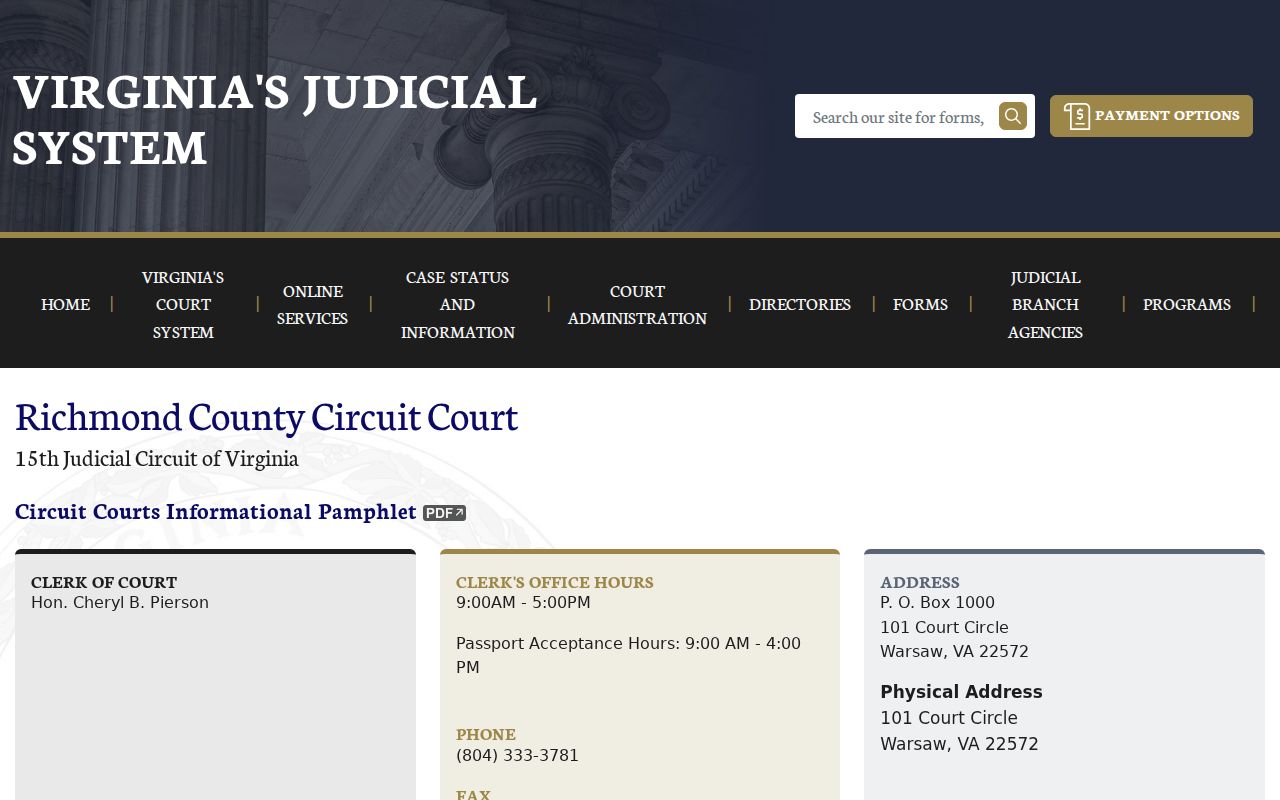
The Clerk's office sits at 101 Court Circle, P.O. Box 1000, Warsaw, Virginia 22572, with weekday hours of 9 a.m. to 5 p.m. A quick call settles the best way to request a specific record. Virginia FOIA gives the office five workdays to respond. That clock covers producing records, not building a chain-of-title analysis for you.
Give the Clerk as much of the citation as you can. Useful details include both parties and the likely recording year. Also give the instrument type and the book and page or document number. The parcel's legal description helps too. If the online index returns several candidates, ask how to inspect an entry before paying for a copy. Image access requires approved subscriber credentials and advance payment under the county's SRA notice. No per-copy fee is published. So confirm the current amount and payment method with the office directly.
Recorded, not guaranteed. The Richmond County deed index shows recorded instruments, not every possible claim or the legal effect of a chain. A complete title review may require a professional examination of deeds, liens, releases, court files and unrecorded interests.