
Trace Former Richmond County Owners
Every chain of former owners in Richmond County begins with the most recent deed. It steps backward, grantee by grantee. Record the essentials at each step: date, instrument type, and party names. Add a book/page or document number. The legal description must still fit the parcel. Because the Clerk's index is party-based, an address alone will not build a chain. When online deed records run out, the Library of Virginia extends the search. It offers older deed books, general indexes, and plats.
| Transfer point | Grantor → Grantee | Instrument / date | Book and page |
|---|---|---|---|
| Newest located deed | Current grantee → prior grantor | Use the date and deed type in the index | Copy the returned reference |
| Prior acquisition | Earlier grantor → same grantee | Match parties and legal description | Carry the next citation backward |
| Older deed-book era | Repeat for each prior owner | Use LVA general deed indexes | Check the cited book and page |
For a recent transfer, begin with the Richmond County Clerk's SRA index. Older citations call for the Library of Virginia catalog. It identifies the right reel and index. Later deeds sometimes recite earlier conveyances. That helps bridge gaps. A missing volume can still break the chain, so match acreage, district, adjoining owners, and landmarks rather than trusting a repeated name alone. The Library of Virginia's Richmond County catalog lists the historical books. Those books and indexes extend a chain.
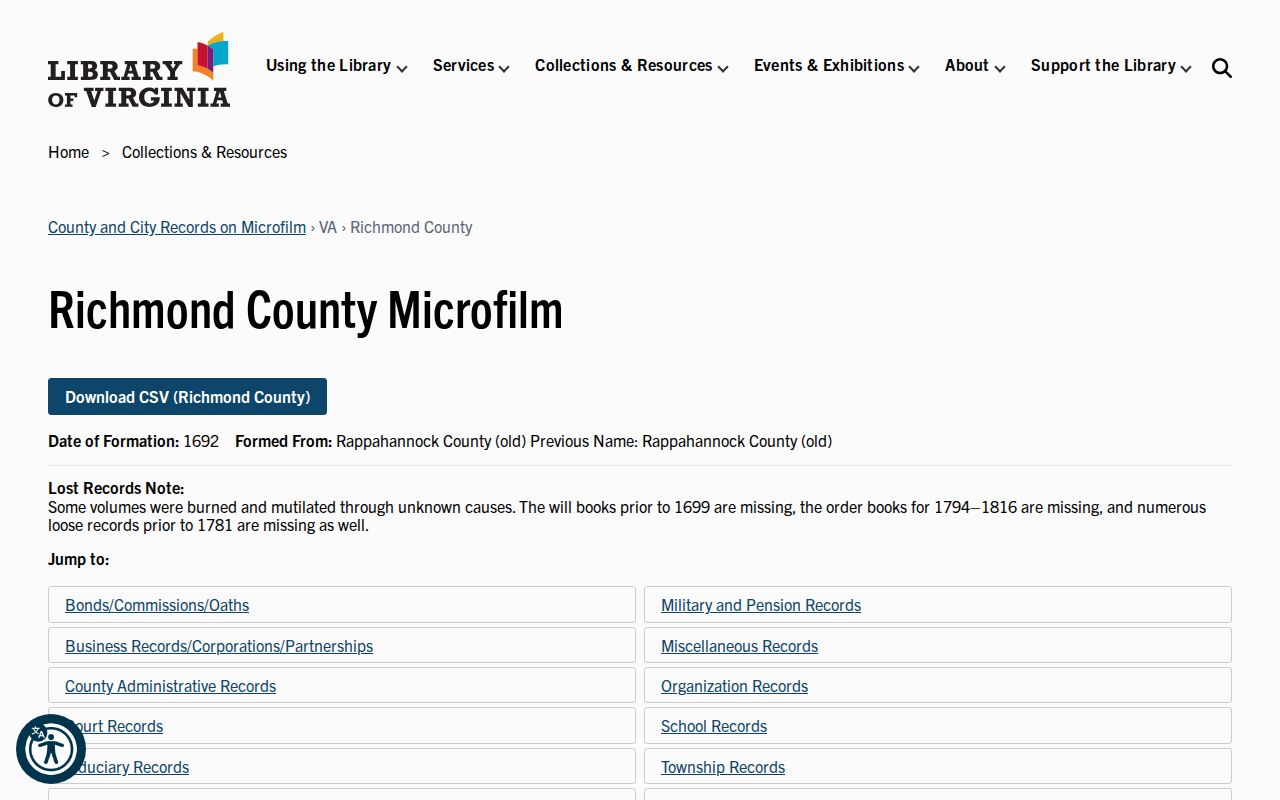
Use the reel and book ranges to plan a lookup when the modern remote index ends. A catalog citation points to the right source. It cannot promise that every volume survives complete or legible, so verify the pages you need.
Richmond County's 1692 Deed Trail
Richmond County was formed in 1692 from old Rappahannock County. Its deed records run deep. The Library of Virginia catalog opens with Deed Book 1, covering 1692–1693. It runs through the cataloged Books 31–39, ending in 1905. Two general indexes organize the span. General Index to Deeds 1 covers 1692–1860, and General Index 2 covers 1860–1915. Together they give a structured route through owners across changing centuries. This holds even when no online image displays the old page.
The reel notes deserve attention. Deed Book 2 and Book 14 share reel 1. Book 1 exists in both transcript and original films. A year can fall near a volume boundary, so read the finding aid before assuming each book maps to one reel. Richmond County's land-record history is unusually deep. Yet depth is no guarantee that every record survived.
Richmond County Index and Microfilm
The county reports that circuit-court records are computerized back to 1753. That is a digitization statement, nothing more. It does not promise free deed images or fully searchable remote fields. The Clerk's SRA page draws the line clearly. Indexing data is public, while images require approved subscriber credentials and advance payment. So a researcher can identify a deed online and still need the counter or a library reel for the original. The Richmond County Clerk's land-record page explains the index and subscriber image access.
For older owners, search the LVA catalog for General Index 1 and General Index 2. Then follow the indexed book and page. Plats from 1801–1888 sit on reel 190. The catalog lists reel numbers, book dates, and page counts. That makes planning a request far easier. Ask the Clerk for current copy options, since the county publishes no per-page deed-copy fee.
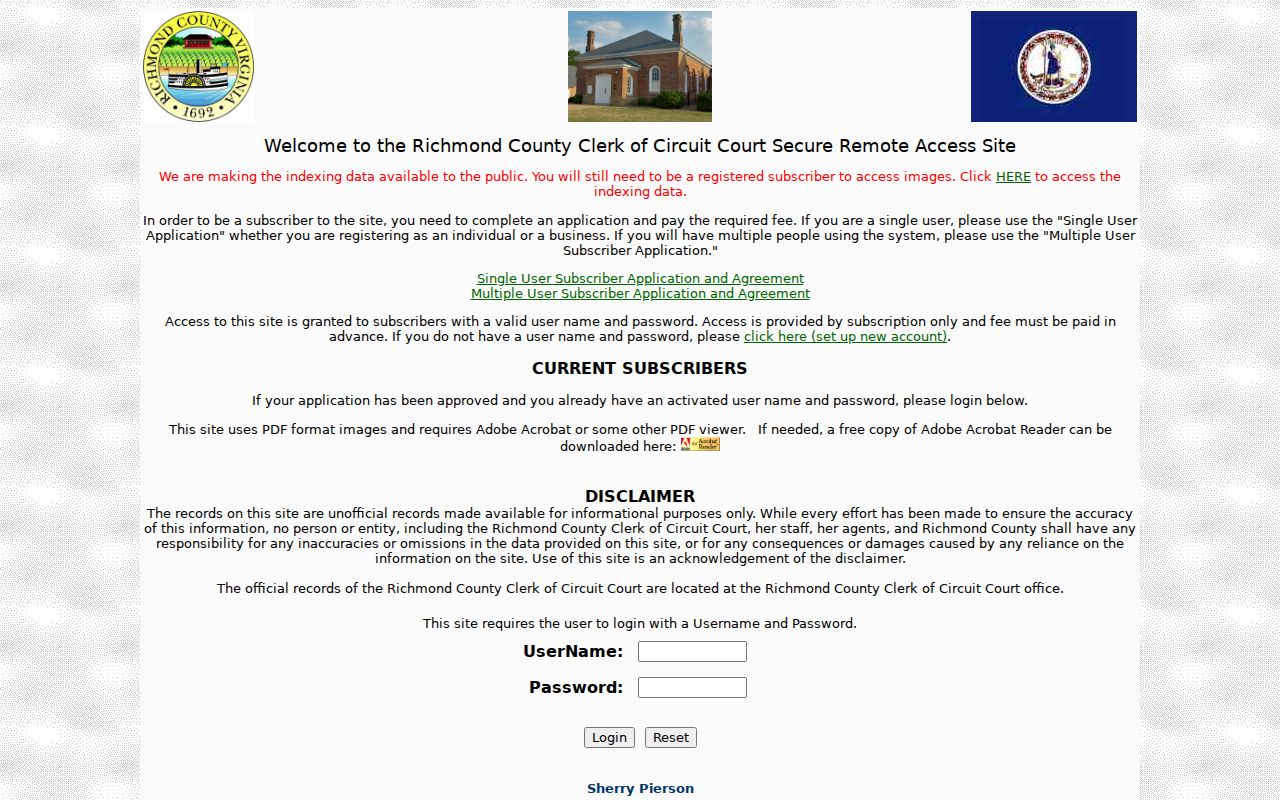
Save the citation even when the image will not open. An exact book/page or instrument number makes any in-person request to the Clerk more precise.
Richmond County's Missing Books
The LVA catalog warns that some volumes were burned or mutilated through unknown causes. Will books before 1699 are missing. Order books from 1794–1816 are gone too. Numerous loose records before 1781 are absent as well. Such losses can explain a break in an otherwise plausible chain. They do not prove a conveyance never happened. Nor do they prove a named owner held land without a transfer.
When an index runs into a gap, widen the search. Try alternate spellings, initials, married names, entity names, and adjoining-owner references. Look for a later deed reciting the older conveyance. Look for a plat naming a source tract. Also try an estate file or a chancery proceeding. An item missing from one series may survive as a copy or clue in another. Keep notes on each volume and index checked. The next search can then target the open link.
Richmond County Estate Transfers
Ownership in Richmond County does not always move by sale. An estate can carry the title instead. Wills, fiduciary appointments, orders of sale, administrator deeds, and executor deeds all leave traces in the land records. Heirs sometimes convey through a deed of their own. The Circuit Court Clerk is the local contact for these instruments. The LVA catalog lists a Record of Fiduciaries from 1850–1903, plus fiduciary bond books and guardians bonds from 1824–1850. Those volumes matter when an old owner of record was a minor or a parcel passed through administration.
Never infer ownership from an obituary. Track down the fiduciary record instead, then the later deed or order that touched the parcel. Virginia death certificates stay restricted for 25 years after death under Code § 32.1-271, subject to exceptions. Deeds and probate records follow their own access rules. When the public index shows no estate link, ask the Clerk about exact-name variants and the right year range for the deed records.
Richmond County Deed Name Variants
Name variants sink more Richmond County chain searches than missing volumes do. The same owner of record can appear under an initial, a middle name, a suffix, or a married surname. Companies change legal names too. A trustee or executor may sign in a different role from the person who actually benefited from the transfer. Search the name in the last deed as both grantor and grantee, then test variants only when a date, parcel description, or adjoining owner supports the match.
Keep maybes apart. Log each candidate's source, book and page, date, and description clue for the deed records. Track the volumes you have covered. This makes a gap easy to revisit. Richmond County's early materials are damaged and missing. A blank result is not a complete history.
Walk the Richmond County Chain Backward
Work each link backward. The grantee in one deed becomes the name to search in the prior deed. The grantor conveyed the interest. A chain of title is the ordered record of instruments affecting the land. The legal description outlasts any old street address. Richmond County's SRA landing page does not publish every live field. Start with the names and identifiers the index actually documents.
- Find the newest deed tied to the parcel and note the current grantee and legal description.
- Search the grantee name in an earlier period and record the deed by which they acquired the tract.
- Take that instrument's grantor as the next prior owner and repeat, checking acreage and adjoining land.
- Move from the modern index into LVA books and general indexes when the remote trail ends.
- Grantor
- The party who conveys an interest in a recorded instrument.
- Grantee
- The party who receives the interest described by the deed.
- Chain of title
- The sequence of recorded instruments that traces a parcel through owners.
- Book and page
- A volume citation for an older Richmond County record.
- Quitclaim
- A deed that conveys whatever interest the grantor has, without a warranty.
Richmond County Historic Plats
Reel 190 at the LVA holds county plats spanning 1801 to 1888. A plat shows lot dimensions. It can also reveal a road dedication, shared access, or an easement. Sometimes it clarifies how a subdivision sits against an older farm tract. Today's county subdivision form still asks for the parent tract's deed book, page, and conveyance date. That mirrors the same link a researcher works backward to find.
Never treat a plat as stand-alone proof of ownership. Pair it with a deed. When a parcel card lists a subdivision name or an instrument number, use that detail to track down the plat. Then compare the source tract description. Roads shift and water features move. Either can change how a tract is described across decades. The recorded text stays the legal reference.
How Far Richmond County Ownership Reaches
Richmond County's land-record trail runs deep. Ownership documents reach back to the county's 1692 formation, and Deed Book 1 covers 1692–1693. The county reports court records computerized back to 1753. The public SRA index and its paid image rules stand apart from that system. For older material, turn to the LVA general indexes and microfilm catalog. It lists book ranges, reel details, and plats so an old reference can be traced without assuming every page is online.
Record gap. Missing or damaged volumes mean a blank index result is not proof of no earlier transfer. Use later deeds, fiduciary records, plats, chancery files and adjoining-owner clues to test the chain. Keep research tied to the parcel and never use former-owner data to harass a living person.